
Ohio Financial Literacy Standards and Mandates
Ohio has mandated that starting with students entering ninth grade on or after July 1, 2022 (the class of 2026), they must earn a half-credit in financial literacy to meet graduation requirements. Although the current mandate represents progress toward ensuring students pick up financial knowledge, it fails to meet the minimum education standards for other core subjects taught in high school; and students who complete the coursework proposed will not be prepared for near-term financial challenges.
While our review is critical, we want to express our gratitude to everyone dedicated to advancing legislation aimed at teaching financial literacy. Thank you for your time and effort in developing this bill to its current stage. Our critique stems from a place of constructive feedback to improve existing mandates and enhance bills to ensure they make a significant and lasting impact on our youth. We are committed to fostering a future where financial literacy is not just taught but is impactful and meaningful for the generations to come.
Ohio Financial Education Mandates Ranking
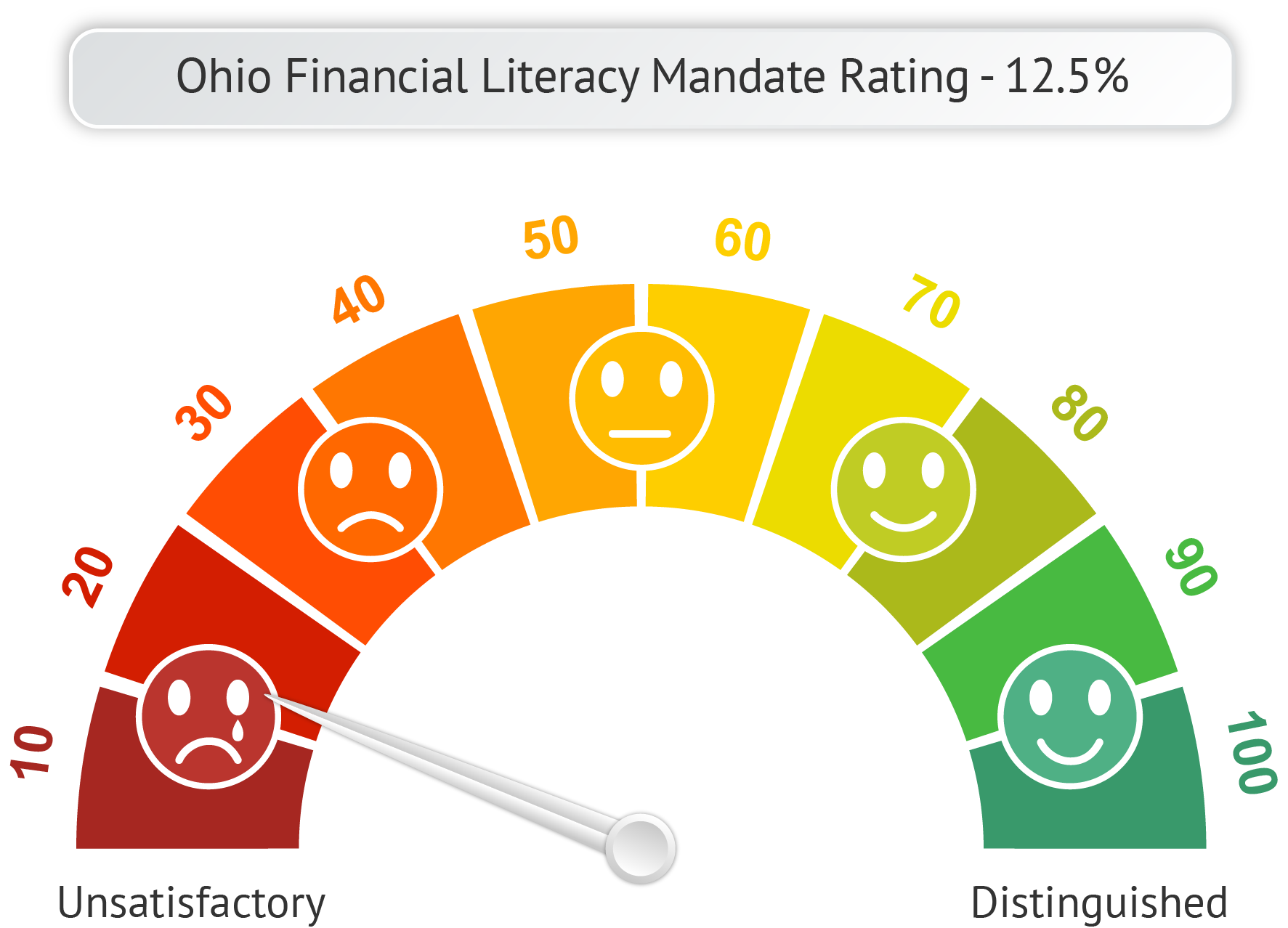
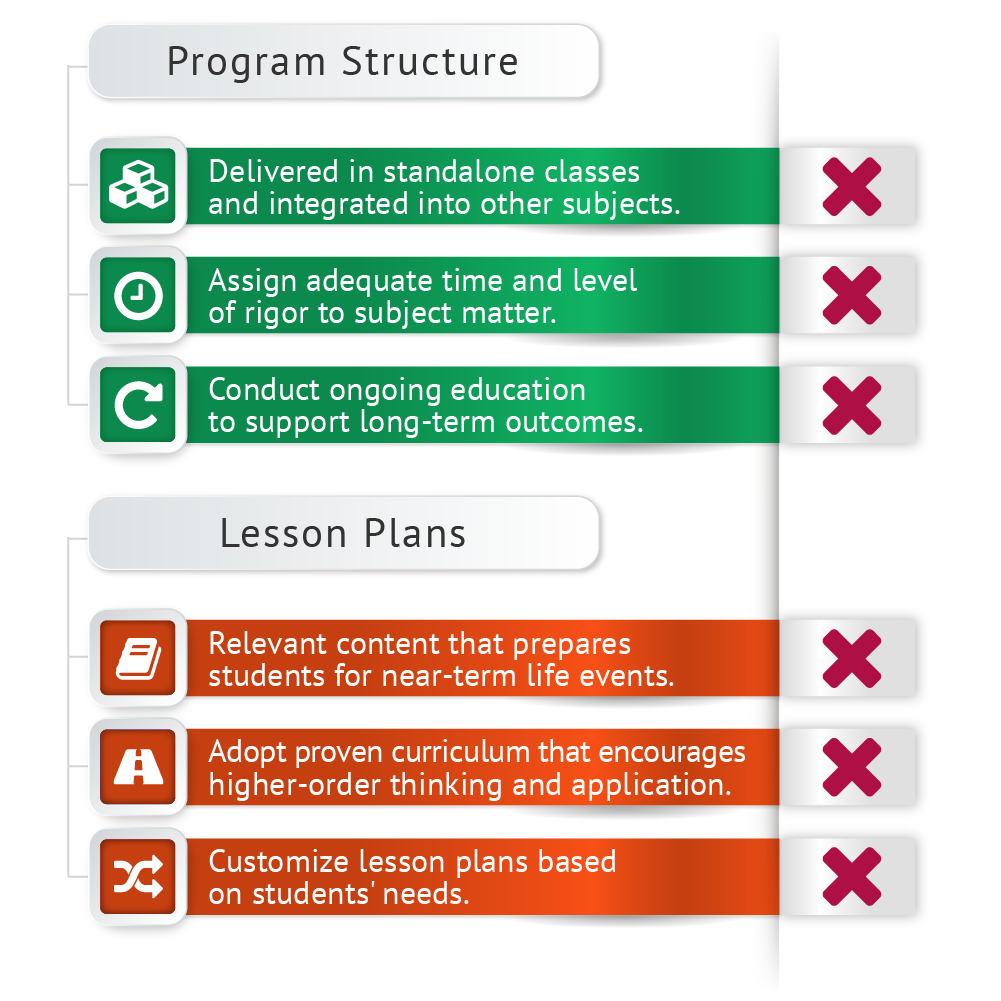
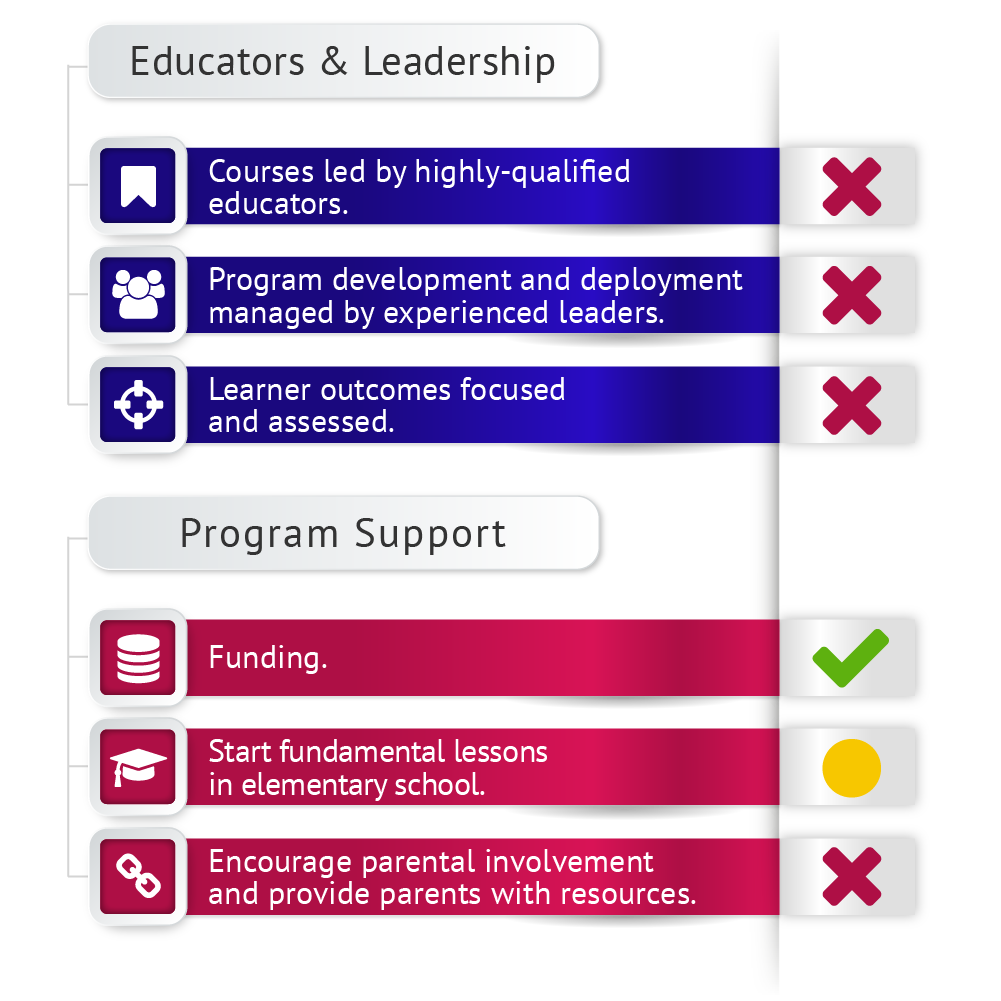
Disappointingly, Ohio’s financial literacy mandate failed on on 10 out of 12 measures. Although well-intentioned, this financial literacy mandate raises concerns, as it lacks many vital elements required to produce positive student outcomes.
A Critical Review of OH’s Financial Literacy Mandates That Took Effect July 1, 2022
Thank you for joining me as I review Ohio financial literacy mandates. We have a new bill here as of 2021 that requires students to graduate with a half a semester of financial literacy education. Let’s get into the bill right now. And before I do that, I always like to say, I likely will be very critical. I have been in all past bills because they fail to meet minimum education standards and because students will graduate not prepared for the basic financial realities of life. This bill is no different, but I’m appreciative of those who have put their effort into passing this bill. I’m appreciative of all that have supplied their work to develop the curriculum and framework standards there. But again, my goal with these videos is to elevate standards so our children are protected when they move out on their own. Let’s dive in and let’s start with something positive. The positive thing is this financial literacy mandate is funded. You may think, well, that should be typical of any bill that’s passed. Well, it’s not, especially in financial literacy. I’ve reviewed bills across the states. The majority are unfunded mandates, which means The politicians tell the school you need to teach financial literacy, but they fail to give them or set aside any money to do so. So that is good. I like two aspects of this. It’s covered. And additionally, they’re setting aside a separate financial literacy fund, which is good. I like when they have a base level funding and a separate financial literacy fund in case anything happens. There is some protection. So I like that aspect. and this is unique to ohio from what i’ve seen i haven’t reviewed all the bills yet about halfway through but this is a great feature so kudos on that point next again it is a requirement uh starting with students in high school they need to take financial literacy as a graduation requirement it’s one uh a half unit which is equal to 60 hours of education Now, when we look at 60 hours of education, the reality is the total education time is 45 to 50, just because of admin time, kids goofing off and so forth. But it is one half of a unit, which is in Ohio equal to 60 hours. Moving through the bill, we have a requirement for teacher training. Now, This sounded very exciting to start, but I got into it and I was less thrilled about it. So this one says here to obtain a license, teachers must obtain a license validation in financial literacy, which means a valid educator license to teach anything in the ninth to 12th grade. In addition, they’re requiring some people to get a license validation specific to financial literacy. However, there’s some caveats that aren’t too exciting. So if we look at here, this is from the Department of Education and Workforce that gets into it a little bit deeper and what they’re implementing. So anytime there’s a bill, there’s always the policy side of things. And then there’s the administration and how they implement it. And this is how they’re implementing that. The first year, which was 2022 when this was implemented, anybody could teach, right? Anybody that could teach 9th to 12th grade could teach personal finance. After 2024, it requires a license to teach the high school level coursework and a financial literacy validation, which sounds great. It means specialized training for the financial educators. It sounded great up until that point, and then the big OR, or educators with current licenses in social studies, family consumer science, and mathematics or business education. The thing that they don’t understand is personal finance is a unique subject that requires diverse skill sets. Every student, it’s completely different than any of the subjects they mentioned here. Let’s take math, for example. Math is very analytical. There’s one plus one equals two. That’s a fact that will always be a fact. With personal finance, every student comes from a different socioeconomic status. Every student has pre-ingrained habits and behaviors. Every student has been influenced by advertisers, peer influencers, social media. Every student has different goals and what they want to do in life, different motivators, and different attainment of wealth they want to achieve. That needs to be understood. You need to understand behavioral finance, psychology, emotional reasons why people are making certain decisions. And any of those subjects, they don’t have that specialized training. So that is a big miss. Every teacher should have very specialized training in this topic. If we look at any other subject, even those subjects mentioned there, social studies, consumer sciences, they had to go through specialized college and learn how to teach that specific subject for years. In addition, their elementary school and high school is full of learning about that subject matter. So they have a sense of confidence when it comes to that. Most teachers that we talk to, most teachers we train when we survey them at the beginning, they lack the confidence in teaching the subject. Many of them are worried about their own personal financial situation. And sometimes those biases creep into the classroom. They don’t understand, especially with math teachers and other analytical-based teachers, they don’t understand that personal finance isn’t mostly analytical. In fact, it’s just the opposite. It’s more emotional and psychological. So there’s major problems there, a big, huge miss. And if we look at most research, I haven’t seen research that has disagreed with me here. The teacher is the primary indicator of student success. So the high quality teacher that has relevant knowledge and confidence in teaching, they’re going to produce much better outcomes than somebody that lacks that. So a big miss, a big failure there. And they could do a lot more because again, teachers are the backbone of what’s in the training. In addition, the other bad thing is some teachers don’t even need to get that license. Even if they aren’t those business and math teachers, they can fight that and say, Hey, I have relevant experience outside. That may be the case, but there should be standardized testing to ensure we’re having the highest quality educators in class teaching our kids. There should be very high standards there, and they should not only possess the content knowledge, but know those other things. Behavioral finance. How do we modify education methodologies to help students develop reasons? How do we leverage project-based learning and visual learning cues in personal finance? A big, huge miss. You’re going to have a lot of unqualified educators teaching our youth about a subject that’s so critically important. If you give some bad information or bad guidance, or maybe it’s a teacher that’s been really beaten up about their own financial issues, and they pass on those negative beliefs to their students, that’s a huge, huge miss. So a big disappointment there on that aspect. Continuing back to this Senate Bill No. 1, They have a committee, right, that’s geared toward implementing these different rules, which I think is great. I think it’s great to have a committee, but the committee, again, is made up of teacher of math, teacher of social studies, business educators, family and consumer sciences, and one financial literacy professional. It makes absolutely no sense. If I’m building a rocket and I’m working on an electrical component of that rocket, I’m going to have… 10 people that have a specialty in that electrical piece in a committee. I will also have other members that can add diverse knowledge on their specialization and how they can add value. I’m not going to just have a bunch of random people that don’t have specialization in the area that this subject matters on. What if it was mathematics? Am I going to bring a social studies teacher into a mathematic thing? Maybe one, but I’m going to have 10 mathematicians, right? It doesn’t make sense. Committees should be made up of experts across the board. Whenever we build out our material, we have content experts, so they know the personal finance topics. We have education methodology experts that help us build out that specific area. We have people from the psychology side and so forth. So we’re bringing in people with specialized knowledge. These other areas, they don’t have that knowledge. Again, I think it’s good to engage these other departments, but it should be heavily weighted toward financial literacy experts, people that have actually conducted successful programming, that have proven outcomes. And they haven’t just done it once. They’ve done it hundreds and hundreds of times. That’s what’s needed. And these other teachers are more than welcome. We want that feedback, but it should be led by true experts in that space. So another big issue there. The one thing I did like about Senate Bill 1 was they did not require, so a lot of these states will list a bunch of random topics that need to be taught, right? At least from what I’ve seen through this bill, they didn’t list out a bunch of random topics. For instance, Massachusetts bill 4199 going through, they list out like 60 topics. One of them was teaching online stock trading. Absolutely insane. The Florida bill that was passed recently listed what to do with inheritance money. So the topics should be dictated by personal finance experts, not politicians, because we’re going to get more relevant information out from them. Let’s slide back into here. So prior to or after this bill, part of what was mandated was also for the department to build out standards and learning outcomes for students. So this is part of this bill here. and which I think is a great thing. It’s important to have clear learning outcomes, clear standards, and clear direction of which way the course is gonna go, but there’s some big problems with what they did. And this was taken from Ohio’s model curriculum, financial literacy. The 2019 one is the most updated version. There’s one in 2018, which was a disaster. 2019 enhanced quite a bit. So it’s looking much better. But I still have major, major problems with this. We’ll take it from the top. First off, the way they group the ages, right? They listed standards for all ages from kindergarten through high school. Now, one positive thing is I’m glad they’re teaching these younger ages. I’m glad they’ve built a framework for learning. That’s so critical. It is missing several things. One is how they broke down the ages. They broke it down kindergarten to third grade, third through sixth grade, middle school, then high school. Now, if we look at cognitive development models, PJ’s cognitive development model, we know that you know, from ages three to seven years old, they’re in the pre-operational stage, which is very conceptual, right? So I’m going to teach a first grader, second grader, different than I’m going to teach a third grader because of the way their brain works, right? In the third grade, they’re getting to more of that concrete operational. This makes a big difference. So take, for instance, if I have this, let me take these things. I have two glasses of water. One in this glass that’s filled up to here. This glass is filled up to the same amount. This glass looks bigger. If I ask a kid in the second grade what what has more, they’re going to say this glass because the glass is bigger. But that is not the case. They have the same amount. Now, somebody in the third grade, they’re going to understand that concept better. And this is critical when you’re thinking about money, right? A student’s going to be able to understand a dollar bill is worth more than five pennies. A kid in kindergarten is going to think the five pennies, they want the five pennies because that’s more. A kid in third grade is going to understand that that is not more, and they can cognitively understand that dollar bill is worth more. So there’s a big problem with the age breakdown. Second, the number of topics. In high school, for the high school topics, they have over 70 topics listed. I counted closer to 100. I want to be very conservative with 70 hours. There’s no way you’re going to be able to cover 70 different topics in one. let’s be realistic 50 hours of education. Yes, I know it’s a it’s supposed to be 60 hours. But through attendance, kids mess around all that thing, all those things add up and take time. So you have a lot of information crammed in, you’re never going to be able to get to higher order thinking skill sets. And that brings me to my last point, which is higher order thinking skill sets. Let’s take a look here. So These are very popular learning models, Bloom’s Taxonomy and Webb’s Depth of Knowledge, which describes the level of understanding we can get students to. At the very bottom, we have recall, reproduction, understanding, remembering. At the top, we have creation and application. And let me just give you a very simple example. If I’m doing a hour class on credit in high school seniors. After an hour, I may be able to get the students to pass a test that shows that they know the actual, you know, there’s three credit bureaus. They may know, hey, you should keep your debt low. You should pay your bills on time. And they should know, hey, a good score of seven, 800 on your credit score. They would know that, right? Now, how is that going to benefit them? And also when you get them to that low level of learning, learning loss is steep and significant. They’re going to forget that after a year unless they apply it. Now, if I can take them to these higher levels, creation, evaluation, analysis, now I can really make a difference. That’s going to take more time, right? It’s going to take more time for sure. But that’s why it’s important we reduce the amount of topics and spend more time on the near-term needs of students. So if I take a student to that creation level, that top level of Bloom’s, they’re going to know how to download their credit report. They’re going to actually download it and analyze it and see if there’s anything on there. Most kids, there won’t be. Some, they have already had some identity theft that’s out there already when they’re in high school. Then they may have, from there, they’re going to understand and create a plan to build their credit They’re going to establish the systems to maintain their credit, maybe their bank account, their bill payment structure and things of that nature. They already have bills in most cases in high school. And in addition, they’re going to calendar when they should download their card, when they should review their credit on an annual basis, right? Or semi-annual, whatever they set aside for themselves. It makes a big difference, especially when they’re applying what they’ve learned now. We significantly reduce learning loss, and they’re applying it, which will help enhance the actual benefit from the lesson. And the language used to convey this is important. Now, the first scary part of I assume that they wouldn’t use the proper language in the model curriculum was when I read the intro. They said the high school model curriculum can be used by districts in a standalone course or integrated into other coursework. So this doesn’t need to be a standalone course. The districts can choose to integrate it. The high school course prepares students to understand financial literacy concepts. Look where understanding is on this higher order thinking skill sets. Help them become savvy customers, prepare students to make sound decisions, provides an overview of different types of insurance, all low-level learning. Only thing they mention of high level learning explains and explains how to create a budget. Even that explains how to create lowers that create. So it’s not saying they need to create a budget, although they do in the standards, but that lowers that. So the only high order thinking skill set they have is creation of a budget. And that’s it. When I go through the actual standards, same thing applies. Identify, describe, list, explain, understand, explore, identify, compare, identify, explain, identify, prepare, explain, identify, tax credit, identify, describe, all low-level order thinking skill sets. I don’t know who wrote these. They’re missing a big part. When we wrote our standards, we partnered with a few groups. First off, we had over 100 different people involved, content experts, psychologists, learning experts, and so forth. We partnered with two of the biggest names in curriculum design, Dr. Heidi Jacobs, well-known for curriculum mapping. In addition, Charlotte Danielson, she wrote the Framework for Teaching, we partnered with her because she said we said hey the framework for teaching doesn’t apply to personal finance because it’s such a unique topic laden with heavy emotions heavy behaviors and she agreed we worked with her consultants to develop a framework for teachers and also learners and the first lesson they taught us was the importance of using the proper language. And the proper language should align with Bloom’s and Webb’s, and not just to be arbitrary, but because that guides the teachers. Standards aren’t just a list of things. They should guide the teachers with clear levels on where they wanna learn. Now, if they realize that because they’re cramming 70 plus topics, into 60, 50, 60 hours of instruction time, then that makes sense. But the outcomes that students will get from this coursework will be minimal. Some will benefit, not at all. Others will be turned off of learning But there’s a huge failure, a huge miss there, and it’s just random topics. Additionally, there’s no clear outcome goals. I want a clear outcome goal that’s based in reality. Students feel confident and prepared to move out on their own. They have completed and created a budget for when they move out on their own, right? They have created a plan to decide on what college path to take, right? All these things are high-level outcomes that should be the basis of any standards, and it should be done through backwards design. Now, I understand they’re mandated by the government to create these, which is fine, but with our standards, we know in developing those, it’s not just you create standards and I’ll throw them out there. You create standards, you go through five, 10, 12 iterations to refine those based on feedback from hundreds of educators, big assortment of groups, and refine those standards. This is just put out there as, okay, go do it. It hasn’t been piloted. It hasn’t been beta tested. And with anything in the education space, that’s a major, major miss. And it puts our students at risk and it puts teachers too, causes them frustration and other problems in teaching class. There’s lax, clear direction. So major problems there. Let’s get into the breakdown of the overall ranking of the standards here. And this is the bill in general, but also a review of the standards and what they’re able to put together. So let’s start off at the top. And again, we look at whenever we rate financial literacy bills, we look at a 12 point assessment, program structure, lesson plans, educators, leadership, and program support, right? Let’s go one by one down. So is this delivered in a standalone class? Sometimes. We’re very clear. It’s up to the district’s discretion on how they deliver it. It can be a standalone or integrated into another class. So I will give them a fail there. Assign adequate time and level to subject matter? Absolutely not. No state really does. This isn’t surprising. Nothing bad on Ohio. This is just typical. They treat financial literacy like it’s just some random topic you can learn in a few hours, right? Absolutely not. It requires the same focus as other subjects to actually benefit students. And I would argue it’s more important than many of the subjects they’re mandating our students take in high school. conduct ongoing education to support long-term outcomes. Nothing was mentioned there. And with technology today, it’s so easy to do so. There’s no progression after high school. There’s no communication mentioned. And it’s very easy to set up because they have all their contact information. Easy to send them timely reminders of things that come up during life events. That’s a big miss there. And again, super easy, super cheap to do. Moving down the list, lesson plans, relevant content that prepares students for near-term life events. I would argue, no, it is a list of random topics. Again, they list 70 different topics. List financial education decisions made at different stages. Yeah, I think it’s important, but why? What are we trying to do here? What’s the outcome? Are we trying to help them move out their own, live independently? We’re trying to help them avoid credit card debt early, letting them know, hey, once you turn 18, you’re going to get inundated with credit card offers. Here’s how to avoid that. What are we trying to do? There’s no mention of really near-term life events. It does have them create a budget, but it does not mention a budget after they graduate, which would be a basic thing. I think the core of any youth financial literacy program is preparing them for the real world, So a big miss there. Adopt proven curriculum that encourages higher order thinking skill sets. A fail there. And in fact, what I’ve seen, I’ve seen two things. One, they have a list of free resources, mainly from financial institutions that are commercial government institutions, which have some biases and some other resources. They’re not investing into curriculum. Second, I saw a contest they have from the Department of Commerce, I believe it is, where they’re going to award 50 grand to all these organizations that can develop something unique for that group. But the highest award would be $15,000. I can tell you what, with $15,000 award, you’re not going to have anything of quality simply because it’s not just developing something, it’s developing, testing, feedback, redoing, and so forth. So a big miss there. And there’s no mention of the curriculum standards in what I’ve seen throughout. Customize lesson plans based on student needs. No mention of that through any of the documentation I’ve seen. And that is critical because somebody in the lower socioeconomic status, I’m going to present this material in a different way than I am somebody that comes from a high socioeconomic family. And you may think, oh, low socioeconomic status are going to be the harder ones to teach. Absolutely not. Actually, they have more of the skill sets when it comes to budgeting, delayed gratification and other things. They lack hope. So there’s uniqueness in the different markets we serve that only somebody that has taught, hundreds and thousands of events would know and can lend that knowledge to them. I don’t know who they consulted on this, but there’s a big missed opportunity there. Courses led by highly qualified instructors, absolutely not. You need specialized training to teach personal finance. So a big miss there. Program development managed by experienced leaders. Yeah, I mean, they did put effort into this, but I just think there’s so many like very obvious things that they’re missing. I mean, not aligning the language to, you know, proven education standards and what you’re trying to achieve. It’s just a big miss in my book. So I would disagree there. Learner outcome focused and assessed, nothing mentioned. They didn’t mention how they’re going to test, how they’re going to do anything. Additionally, with personal finances, not just pre and post tests. We need to measure behavior adoption. They’re willing, if they’ve changed in their willingness to adopt new positive behaviors, their confidence on financial matters, if they’ve actually taken steps, if they built out any systems like in high school, did they open their bank account? Easy things to measure that would really prove the impact of the program. That should be the focus of any bill when it’s passed. They failed to mention that. Now, I will give them a green star here, a green check. Funding. Congratulations. This is the first one I’ve given a green check on funding because they have two key things that I like. One, they have general funding. Second, they have an established financial literacy fund. I like that backup. So great job, Ohio, with actually putting your money where your mouth is. So good job there. But let’s use that money to make a good program. Let’s leverage that. with money a lot of things can happen a lot of good things can happen in in really with the work they put in the the structures i don’t want to beat them up too bad right they’ve done a lot better than than most states and again a lot of states uh when they get these uh mandates from the the legislation mandates on to teach the administration just kind of throws those in and they don’t really build out to it but obviously the administration took time to develop things so i i do want to take time to recognize them for their efforts to develop things it just Let’s leverage that money with experts in that space. So it’s truly quality material where we’re going to see true outcomes. I’ll start fundamental lessons in elementary school. Now there’s no mandates for that on the bill side. Okay. I love the fact that they have the framework and structure. Okay. So I, I, I, I’m happy for that, but there’s no mandates there that say, Hey, you have to teach, but because they built the structure and, I want to give them a yellow mark. It’s way more than than most states have done. So although it’s not it’s definitely not a green check. It could be a red X, but I think they’ve done more than most. So I want to err on the side of being generous there with that. But I’m appreciative that they are thinking about the kids. Again, it just needs to align better with their cognitive stages. And the outcomes need to be more clearly presented to instructors. It’s just I won’t get too much. I could spend five hours on reviewing the standards there. But there’s a lot of issues with clarity to the instructors and what they’re trying to achieve there. Encourage parental involvement with the resources. Fail. No mention of that at all. And really, especially with kids, you need parents involved. They’re the ones that are shaping behaviors. They’re the ones that can do things at homes. Parental involvement is key with this subject matter. In addition, with high school, it’s important at all ages, right? Anytime a parent can shape and mold positive behaviors through chores, through teachable moments, through other aspects, it’s important. Schools are missing a huge opportunity by not engaging parents in helping the teacher. So what do we have here for Ohio? A bunch of Xs, a green check, a yellow circle. Not too impressive there. However, again, better than some states, worse than others I reviewed, but that doesn’t, I mean, yeah, it’s just sad. All we’re asking for is nothing crazy. People hear my reviews and say, that’s a lot for schools to do. No, all we’re asking for is for schools to meet minimum education standards. If we look at any other topic, they’re going to require clear outcomes. They’re going to require qualified teachers. They’re paying for quality curriculum. They’re going to require… these things to have a functional classroom experience. But for some reason with financial literacy, oh, you don’t need to meet minimum education standards. Oh, we’ll just throw it in as a semester course, even though they haven’t been taught their whole life. Oh, they should pick it up. Imagine trying to speak Spanish after one semester. right imagine trying to learn anything that’s complex after one semester it can’t be done why do they think it will happen with personal finance we need to get these people from just wanting the feel good of oh i’m promoting financial literacy to making a real difference in youth lives that’s one second all we want is it for them to meet uh to get students ready for near-term challenges. I’m not saying get them ready for investing. I’m not saying get them ready for retirement. Although it would be ideal in a perfect world for me, all I want schools to do is prepare them for the near-term things that get people in trouble. What gets people in trouble early? debt, student loan debt, messing up their credit, not being able to move out on their own, not able to get a job. Students graduate without a resume, without ever practicing an interview, without knowing how to shake a hand. It’s embarrassing that they spend 12 years in school and they have no knowledge. They cannot get a job without training. They haven’t been training customer service and other soft skills that are important for hiring. So again, I’m asking for two things, and we outline this in our standard framework and we make this available to everybody complimentary. And it’s called the Policy and Framework Standards for Financial Literacy Education. It outlines these areas of what they need to include in their bills and how administration need to apply financial literacy education. That is there and available for them. It breaks down everything into just meeting those minimum education standards so our kids can graduate and enjoy the life we want for them, right? Everybody says, oh, I want what’s best for the kids. I want what’s best. Well, then we need to evolve and elevate education now so it’s up to date with modern day workforce and they’re prepared for the financial realities of life. Hate to be so hard on these states that are mandating financial literacy, but it needs to be done. So we’re elevating standards so our kids are protected. If you like these videos, please join me. I put these out. You put them out for about 16 more weeks as I finish up the final reviews. But there’s a lot of states that don’t have mandates. If you want to be involved in any advocacy and promoting higher standards, reach out to us. It’s time our kids are prepared. And I thank you.
Ohio Financial Literacy Mandates
Recommended Policy for OH Financial Literacy Programs
To address the gap in standards for personal finance education, the National Financial Educators Council has developed a set of benchmarks for all grade levels, K-12. This policy guide offers legislatures a framework that standardizes educational quality and learner outcomes to provide the best possible financial education for American youth.
The Standards Guide is based on the notion that financial education should be treated the same as any other topic taught in schools and that all students should at minimum be capable of making near-term financial decisions.
